Clean label en productos plant-based

Clean Label in Plant-Based Products: What Is Viable Today and What Isn’t?

  • Clean label in plant-based is a retailer-driven priority, but simplifying labels without losing texture, stability, shelf life, or cost efficiency is technically complex and often requires smart trade-offs.
  • What’s feasible today: reduce ingredient count using multifunctional protein/texturate systems, fibres/starches/flours, and focus on formats where perfect meat-like mimicry isn’t expected (fillings, sauces, ready meals).
  • What remains challenging: achieving a fully meat-like experience with very short labels, removing key tech ingredients without impacting shelf life, and keeping costs competitive—so projects need clear targets, pilot validation, and scale-ready testing.

Clean label formulation has become a strategic priority in the European plant-based sector. Retailers increasingly demand shorter ingredient lists, fewer additives and products aligned with evolving consumer expectations. However, achieving this without compromising texture, stability, shelf life or cost efficiency remains highly complex.

This article explains what can realistically be simplified today in clean label development, what is not yet feasible without trade-offs, and how manufacturers can approach clean label reformulation in a technically sound and commercially viable way.

What Does Clean Label Mean in Plant-Based Formulation?

Clean label is not simply about removing E-numbers. From an industrial standpoint, it means designing formulations with:

  • shorter and more transparent ingredient lists
  • reduced use of additives perceived as artificial
  • recognisable raw materials
  • clear alignment between consumer perception and technical formulation

Clean label does not mean “unprocessed”. It means a simpler, more transparent formulation that remains technically justified and commercially feasible.

European consumers increasingly prioritise products with recognisable ingredients and lower perceived processing, influencing retail acceptance across Europe.

Why Clean Label Is Especially Challenging in Plant-Based Products?

Plant-based proteins such as pea, soy or other legumes do not naturally reproduce the fibrousness, juiciness or elasticity of animal proteins. For this reason, achieving a high-quality sensory profile often requires multifunctional ingredient systems.

Functional Challenges: Texture, Emulsion, Water Retention and Stability

One of the most common formulation challenges is water retention.

Plant-based burgers, for example, frequently lose water during cooking, affecting:

  • texture
  • juiciness
  • yield

To address this, formulations must incorporate ingredients that improve water absorption and water-holding capacity, without disrupting the balance of the product.

Other essential variables include:

  • emulsification
  • gelation
  • hot structure
  • behaviour during regeneration or reheating

Removing ingredients without understanding their functional role typically results in instability or inconsistent product performance.

Commercial Challenges: Cost, Availability and Scalability

Clean label must remain compatible with:

  • target cost
  • raw material availability
  • consistent industrial production

A cleaner label must not compromise margin, repeatability or operational performance.

What Is Viable Today in Clean Label Plant-Based Development?

Despite the challenges, several strategies allow meaningful simplification without affecting industrial results.

Multifunctional Ingredients to Reduce Complexity

Using ingredients that perform multiple functions—such as providing protein and structure, or fibre and water retention—helps reduce the total ingredient count.

Examples include:

  • pea or soy texturates
  • legume-based blends
  • functional protein concentrates

These solutions support simpler formulations while maintaining technological performance.

Replacing Complex Systems with Fibres, Starches and Functional Flours

It is increasingly feasible to replace part of complex systems with:

  • plant fibres
  • functional starches
  • technological flours

Such ingredients offer stronger consumer acceptance and can maintain required performance when used appropriately.

Targeting Categories Where a Perfect Animal-Like Replica Is Not Expected

Clean label is most realistic in applications where the consumer does not demand an exact imitation of meat or dairy:

  • ready-meal fillings
  • plant-based ragù or sauce bases
  • heat-and-serve solutions
  • granulated or bite-size formats

In these categories, functionality and flavour tend to outweigh expectations of perfect mimicry.

What Is Not Yet Fully Viable?

Understanding the real limitations avoids unrealistic development pipelines.

Replicating a Fully Meat-Like Experience with a Very Short Ingredient List

High sensory expectations require technological aids that are difficult to replicate with minimalist formulations.

Removing Key Technological Ingredients Without Affecting Shelf Life

Avoiding preservatives often requires adjustments such as:

  • thermal treatments (e.g., pasteurisation)
  • changes in packaging technologies
  • more complex processing stages

These changes may increase cost and operational requirements.

Maintaining Competitive Costs in Aggressive Clean Label Reformulations

Clean label does not automatically reduce cost. In some cases, it increases total cost due to:

  • more complex processes
  • shorter shelf life
  • greater operational variability

How to Approach a Clean Label Plant-Based Project Successfully

A structured approach helps prevent technical bottlenecks and production delays.

Identify the Product’s Critical Functional Requirement

Determine which variable is non-negotiable: texture, stability, shelf life or cost.

Define the Clean Label Target Level from the Beginning

Clean label ranges from moderate simplification to deep reformulation. Setting the target early prevents unfeasible development paths.

Validate at Pilot Scale Before Industrial Implementation

Laboratory results must be supported by industrial testing, including:

  • in-line performance
  • sensory evaluation
  • shelf-life analysis

SANYGRAN: Tailor-Made Solutions for an Efficient Clean Label Transition

By integrating ingredient development with final product formulation, Sanygran enables manufacturers to:

  • improve texture and water retention
  • reduce formulation complexity
  • optimise the balance between functionality and cost
  • minimise development iterations and time-to-market

This approach allows companies to advance towards clean label with greater control, improved consistency and reduced risk during development.

Contact:
📞+34 937 132 324
📩 info@sanygran.com

Vegan and plant-based labelling

Vegan and plant-based labelling: mistakes that can block your product in retail

  • In retail, labeling is a real gatekeeper: mistakes in product naming, claims, or documentation can stall approval, force packaging rework, and delay launches for weeks.
  • Typical blockers include poorly defined claims (vegan vs plant-based), “conflict” naming, inconsistencies between label–spec sheet–retailer portals, and weak allergen/trace management.
  • The fix is to design for the retailer review process: solid claim substantiation, critical minor ingredients checked, clear use of icons/certifications, and a technical pre-submission checklist.

Vegan and plant-based labelling is not just a packaging element: it is a real gatekeeper for retail entry.

A mistake in product naming, claims or documentation can delay a launch by several weeks, force packaging redesigns, or even block a product from entering a retail chain altogether.

In a fast-growing plant-based market, where retailers are becoming increasingly strict, labelling has become a critical step for any manufacturer looking to launch or scale plant-based products.

This article explores the most common labelling mistakes that genuinely delay products in retail and how to avoid them from both a technical and commercial perspective.

Why incorrect labelling can block plant-based products in retail

In practice, labelling is not validated just once. It goes through multiple stakeholders — including procurement, quality, and regulatory teams — and in many cases external retailer platforms that extend approval timelines.

This is where most bottlenecks occur: technically developed products that do not progress through retail onboarding, packaging that requires redesign, or claims that fail internal retailer validation.

The business impact is direct. A labelling issue can delay a product launch by several weeks or more than a month, particularly when it involves reprinting packaging or correcting technical documentation.

This is not only a legal issue. It is an operational efficiency and time-to-market issue.

Mistake 1: using “vegan” and “plant-based” as if they were legally and commercially equivalent

Although often used interchangeably in marketing, “vegan” and “plant-based” do not create the same expectations in retail environments.

Quick definition:

  • “vegan” implies a complete absence of animal-derived ingredients and full control over this status.
  • “plant-based” is a broader concept, more flexible, and in many cases more ambiguous.

Problems arise when both terms are used without being technically substantiated.

What retailers expect when they see “vegan”?

When a product is labelled as “vegan”, retailers interpret it as a high-risk claim that requires validation.

This includes ingredient verification, supplier assessment, cross-contamination risk analysis, and consistency between recipe, technical specification and packaging.

Without sufficient documentary evidence, the claim is challenged and the approval process stops.

What “plant-based” means in an industrial context?

“Plant-based” may appear easier to use, but it also creates uncertainty if its scope is not clearly defined.

A product may be predominantly plant-based but still include flavours, carriers or processing aids that require additional validation.

The more ambiguous the claim, the higher the friction during technical review.

Mistake 2: choosing a product name that retailers consider high-risk or non-compliant

Product naming is not only a branding decision. It is a key validation checkpoint in retail onboarding.

At European level, the use of certain terms is restricted. A relevant example is the case TofuTown v Verband Sozialer Wettbewerb, which confirmed that dairy-related terms such as “milk” or “butter” cannot be used for plant-based products.

Beyond legal requirements, many retailers apply even stricter internal standards.

High-risk terms in plant-based alternatives

In practice, certain terms frequently trigger review delays or listing blocks:

milk, cheese, yoghurt, chicken, burger, steak

Even when some terms may be defensible in certain legal contexts, if they raise doubts at retailer level, the process slows down or stops.

How to create compliant naming without losing commercial strength?

A common way to reduce friction is to separate legal naming from commercial messaging.

From a technical perspective, formulations such as “plant-based preparation based on…” or “product made from…” are often used.

On the front of pack, a more commercial approach can be maintained, as long as the plant origin of the product remains clear.

Mistake 3: launching a front-of-pack claim that is attractive but poorly supported by documentation

A front-of-pack claim is not valid because it is widely used in the market. It is only valid if it can be substantiated with technical evidence.

This is one of the most common reasons for retail rejection during product onboarding.

Minor ingredients that often break claims

Issues typically arise from secondary components such as flavours, additives, processing aids, carriers or compound ingredients.

Even if the base formulation is plant-based, a single non-aligned component can create uncertainty during retailer validation.

Why consistency between documents is critical

In many cases, the issue is not the formulation itself, but the lack of alignment between:

  • Packaging artwork
  • Technical specification sheet
  • Retailer product data platforms

Any inconsistency between these documents can pause the approval process until everything is fully aligned.

Mistake 4: forgetting that “vegan” does not replace allergen management

A vegan product is not automatically suitable for consumers with food allergies.

Quick definition:
vegan does not mean allergen-free

The most common misunderstanding in plant-based products

A product may contain no animal-derived ingredients, yet still carry cross-contamination risks due to shared production lines or processing environments.

This is particularly relevant in facilities handling soy, gluten or other regulated allergens.

What to check before applying “may contain” statements

The use of precautionary allergen labelling (“may contain”) must be based on a real risk assessment, including:

  • Production processes
  • Cleaning validation
  • Line segregation
  • Supplier controls

Inconsistent use of allergen statements can reduce retailer confidence and affect consumer trust.

Mistake 5: relying on a label or icon without understanding what it actually certifies

Not all visual elements on packaging carry the same regulatory or commercial weight.

Certification, claim and icon: not the same level of validation

  • A certification implies independent external verification
  • A declaration is the responsibility of the manufacturer
  • An icon is purely a visual communication tool

Confusing these levels can create serious issues during retail compliance review.

When certifications actually help unlock retail approval

Certifications add value when they:

  • Reduce uncertainty during product validation
  • Support cross-market consistency across European retail chains
  • Accelerate onboarding processes

However, they do not replace robust technical documentation or formulation control.

Mistake 6: designing labelling for marketing instead of retail validation requirements

Labelling must pass multiple internal filters within a retail organisation.

Each department evaluates different aspects, and the product must comply with all of them:

  • Buying / procurement teams
  • Quality assurance teams
  • Legal and regulatory teams

Key questions retailers ask before approval

Retailers typically need clarity on:

  • What the product is, exactly
  • How it is legally named
  • Which claims are included and why
  • What documentation supports them
  • Whether all information is consistent across systems

Any uncertainty at this stage can delay or stop the listing process.

Most common artwork issues that trigger rejections

Typical problems include:

  • Ambiguous or overstated claims
  • Unclear or non-compliant product naming
  • Confusing or inconsistent icons and visual cues
  • Differences between market versions of packaging

Late-stage corrections often result in redesign costs and delayed launches.

Technical checklist before presenting a vegan or plant-based product to retail

Before submitting a product to a retail chain, it is essential to validate:

  • Correct legal product name
  • Fully justified product claims
  • Reviewed critical ingredients
  • Defined allergen management strategy
  • Complete and aligned technical documentation
  • Consistency across all communication assets

What is not validated at this stage often becomes significantly more costly later in the process.

How Sanygran supports retail-ready plant-based product development from labelling design onwards

When labelling strategy is integrated from the early stages of product development, it is possible to anticipate the critical points that typically cause retail bottlenecks.

This approach helps to:

  • Reduce late-stage product reformulations
  • Avoid last-minute packaging changes
  • Speed up retail approval processes
  • Improve overall time-to-market efficiency

Integrating product development, ingredient selection and technical review from the outset enables faster and smoother market entry across European retail channels.

Considerations before choosing your Plant-Based protein supplier for vegan food production

In today’s world, the demand for vegetable and vegan products is steadily rising. More and more people are adopting vegetarian or vegan lifestyles, leading to increased production and consumption of plant-based foods.

If you’re interested in developing vegan food products, selecting the right vegetable protein is crucial. As plant-based protein suppliers and manufacturers of vegan food, we have first-hand knowledge of the best proteins for each product. In this article, we will explore the key factors you should consider before selecting the right plant-based protein for developing vegan food products.

1.- Nutritional Requirements

Before settling on a plant-based protein source, it’s crucial to understand the nutritional requirements of your final product. How much protein do you need per serving? What other nutrients, such as fiber or fats, do you want to include in your product? Ensure that the chosen protein meets these requirements.

Also, remember that both excess and deficiency in protein intake can be harmful to health, so controlling the amount consumed in products is essential.

“Too much protein can put a strain on the kidneys, as they may be damaged by having to eliminate the excess urea produced when metabolizing proteins.” – Ministry of Health.

2.- Taste Profile

Taste is a fundamental aspect of any food product. Different vegetable proteins have distinct flavours. For example, fava bean protein and textured vegetable protein such as textured pea protein, may have a more neutral taste compared to other options. Evaluate how the protein’s flavour integrates into the final product, and if necessary, consider using natural flavourings or complementary ingredients to enhance the taste.

3.- Texture and Functionality

Texture is a crucial factor for vegan food production companies. Some consumers seek a similarity to animal-based meat, while others prefer exploring new textures. It’s important to tailor your product to your target audience. Consider whether you want a smoother texture or a firm chew. For instance, textured pea protein provides a unique texture and can be used in products like meatballs, sausages, croquettes, fillings, or even in developing pea protein burgers.

Picadillo with pea protein
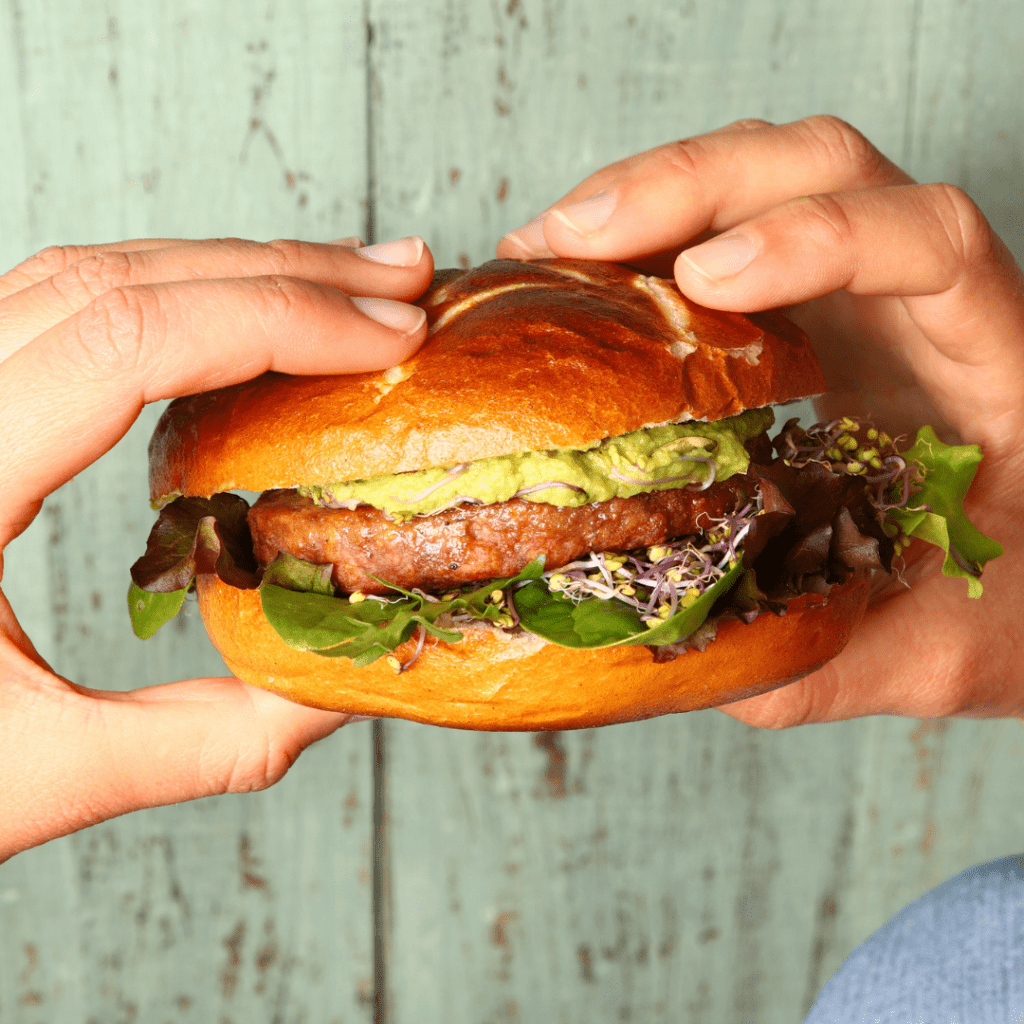
Pea protein burger

4.- Processability

Ease of processing is essential, especially at an industrial level. Ensure that the chosen plant-based protein can be mixed, moulded, and cooked according to your production needs. For instance, bean proteins, especially fava bean protein, are highly soluble, making them ideal when seeking a homogeneous result.

5.- Environmental Considerations for plant based ingredients suppliers:

Many plant-based food companies are seeking plantbased proteins not only for their nutritional benefits but also for their environmental advantages. Before selecting your plant-based protein, investigate how its production affects the environment and whether it aligns with your values and your potential customers.

At Alimentos Sanygran, we commercialise vegan gluten-free protein powder extracted through a process called Dry Fractionation, a clean and sustainable method that uses no water, additives, or chemicals. If you are looking for starch, concentrate, or protein flour, please contact us to explore our offerings.

In summary, choosing the right plant-based protein developing vegan food products is a process that involves multiple considerations, from nutritional and taste aspects to environmental concerns. Fava bean protein and textured pea protein are popular options, but selecting the one that best suits your specific needs and goals is essential.

If you still have doubts after reading this article, don’t hesitate to contact us and partner with us. We can kickstart your plant-based food project with informed decisions!