Multifunctional Ingredients in Plant-Based Products
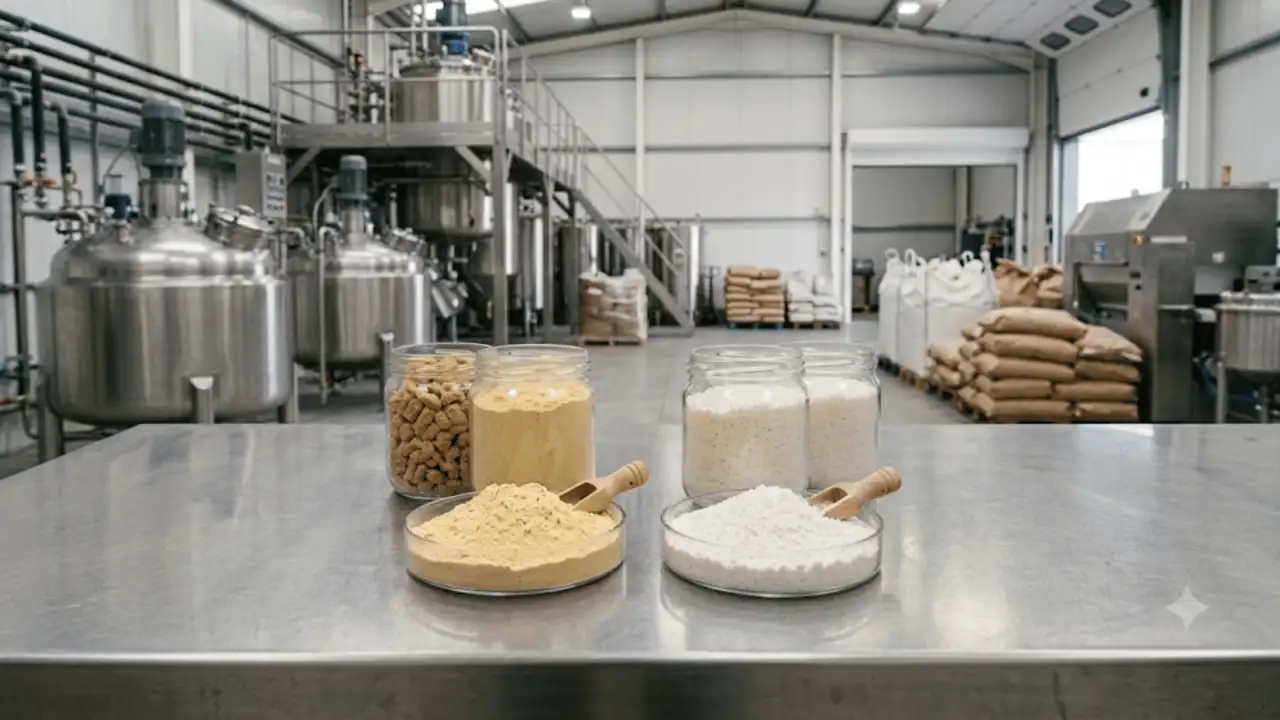
- Multifunctional ingredients combine several functions in one solution: protein, texture, bite, water retention, cohesion, stability, and industrial performance.
- They reduce complexity in formulation and production by lowering the number of raw materials, improving traceability, simplifying suppliers, and enhancing batch-to-batch repeatability.
- They must be selected according to the real application and process: matrix, hydration, temperature, flavor, appearance, and shelf life should be validated at pilot scale before industrial scale-up.
Multifunctional ingredients in plant-based products are becoming increasingly important for the food industry, helping manufacturers develop products with a better nutritional profile, improved texture, greater process stability and enhanced industrial performance.
Choosing ingredients that perform multiple technological functions can simplify formulations, optimise production and support the development of high-quality plant-based foods for retail, foodservice and prepared meals.
What does a multifunctional ingredient contribute to a plant-based formulation?
In the plant-based food industry, ingredients are no longer valued solely for their nutritional contribution. They also play a fundamental role in the structure, stability, juiciness, texture and overall behaviour of the product throughout the manufacturing process.
A multifunctional ingredient stands out because it can solve several formulation challenges simultaneously. Instead of incorporating multiple ingredients to perform separate functions, it delivers several technological benefits within a single solution.
For R&D, production and procurement teams, this can help develop more consistent products, simplify raw material management and reduce formulation complexity.
Technical functions a multifunctional ingredient can combine
Depending on its composition and the final application, a multifunctional ingredient can perform several technological roles within the same formulation.
The most common include:
- Plant protein enrichment
- Texture and bite development
- Water retention
- Improved cohesion
- Stability during cooking or reheating
- Enhanced processing efficiency
A good example is Legumeat, a solution developed by Sanygran that combines soy, rice and beans to deliver both nutritional value and technological functionality within a single ingredient.
In addition to providing a high protein content (50 g per 100 g), this blend helps build product structure, improves hydration and contributes to more consistent performance during industrial processing.
Similarly, textured pea proteins combine a high protein content with structural properties that help create the product matrix and improve processing performance.
Why do multifunctional ingredients reduce formulation complexity?
The more functional ingredients a recipe contains, the more complex product development, sourcing and quality control tend to become.
In many cases, the goal is not to add more ingredients, but to choose those that genuinely deliver greater value.
An ingredient capable of performing several functions can help reduce the number of raw materials required, simplify supplier management and improve both traceability and process standardisation.
This does not mean that a shorter ingredient list is always better. Rather, a more efficient formulation is often easier to control, reproduce and scale industrially.
Industrial applications where multifunctional ingredients deliver the greatest value
Multifunctional ingredients do not perform the same way in every product category. Their behaviour depends on both the formulation and the manufacturing process, as well as the characteristics required in the final product.
For this reason, selecting the right ingredient for each application is far more important than simply choosing the option with the highest protein content or the lowest cost.
Prepared meals and ready-to-eat products
In plant-based prepared meals, formulations must maintain their properties throughout manufacturing, storage, distribution and, in many cases, consumer reheating.
Multifunctional ingredients help maintain stable texture, effective water retention, consistent batch-to-batch performance and overall product stability throughout its shelf life.
Refrigerated and frozen plant-based products
Refrigeration and freezing expose products to particularly demanding conditions.
During these processes, issues such as syneresis, moisture loss and texture changes may occur.
Selecting ingredients capable of performing multiple functions helps minimise these effects and improves product performance after thawing or reheating.
Retail products requiring high stability
Products destined for the retail market must remain consistent from the production line to the consumer’s table.
In categories such as plant-based burgers, prepared meals, chilled products and meat alternatives, visual appearance and functional stability are just as important as nutritional quality.
Technical criteria for selecting a multifunctional ingredient
Ingredient selection should never rely solely on a technical specification sheet or on the number of functions an ingredient claims to perform.
There is no universal multifunctional ingredient. A solution that performs exceptionally well in a plant-based burger may behave very differently in a filling, sauce or prepared meal.
The key lies in understanding how the ingredient interacts with the rest of the formulation and how it behaves throughout the industrial process.
Compatibility with the formulation and processing conditions
The performan76ce of any ingredient depends on the environment in which it operates.
Factors such as hydration, temperature, mixing, thermal processing and the composition of the plant-based matrix can significantly influence its functionality.
For this reason, validation should always be carried out within the specific application for which the product has been developed.
Impact on texture, flavour and appearance
Technological functionality must always go hand in hand with a positive sensory experience.
An ingredient may improve protein content or processing stability, while also influencing bite, juiciness, flavour profile or the final appearance of the product.
Therefore, the formulation should always be assessed as a whole rather than focusing on a single parameter.
Industrial advantages of using multifunctional ingredients
Using multifunctional ingredients provides benefits beyond technical performance. It can also improve the overall efficiency of a project.
A well-optimised formulation can simplify purchasing, reduce the number of raw materials, streamline supplier approval and improve process repeatability.
Furthermore, reducing formulation complexity makes it easier to maintain consistent quality between production batches and achieve more reliable manufacturing performance.
Another important consideration is that the value of an ingredient should never be assessed solely by its price per kilogram. Manufacturers should also evaluate its yield, its ability to reduce waste, the stability it provides and its overall impact on industrial performance.
Formulation challenges and critical validation points
Despite their many advantages, multifunctional ingredients must be carefully validated before industrial production.
Proteins, starches, fats and fibres interact continuously within the formulation. Changing one component can influence the behaviour of all the others.
For this reason, validation should always focus on the complete formulation rather than on individual ingredients in isolation.
Before industrial scale-up, pilot trials are recommended to evaluate performance, stability, processing behaviour and batch-to-batch consistency.
How Sanygran supports plant-based ingredient development
Developing a multifunctional ingredient does not end with selecting the right raw material. Its real value is demonstrated when it performs consistently under real inddustrial manufacturing conditions.
At Sanygran, we develop textured pea and soy proteins, protein blends such as Legumeat, as well as functional ingredients including yellow pea protein concentrate and pea starch, all of which are incorporated into our own plant-based finished products.
This dual expertise, as both an ingredient manufacturer and a finished product manufacturer, gives us first-hand knowledge of how these solutions perform during processing, storage and throughout the product’s shelf life.
As a result, we help food manufacturers select the most appropriate ingredients for each application, reducing development iterations and facilitating successful industrial scale-up.
Because a multifunctional ingredient proves its value not on a specification sheet, but on the production line, where it consistently delivers the quality, stability and performance required for a successful finished product.
Other articles you may be interested in:
- Plant-Based Food Development
- Plant-Based Solutions Provider
- Plant-Based Burger Supplier
- Wholesale Pea Starch Supplier
- Organic Tofu Supplier
- Organic Hummus Supplier
- Plant-Based Chicken Supplier
- Plant-Based Beef Supplier
- Plant-Based Seafood Alternatives Supplier
- Vegan Tuna Supplier
- Plant-Based Meat Analogues Supplier
- Pea Protein Concentrate Supplier
- Plant-Based Chunks Supplier
- Texturised Plant-Based Meat Supplier